December 11th, 17—
Walton's Letters Begin
Robert Walton writes to his sister Margaret Saville from St. Petersburgh, describing his preparations for a voyage to the North Pole. He expresses his ardent desire for discovery and his hope to find a passage near the pole, as well as his longing for a friend to share his ambitions. The letter establishes Walton's character as a driven, romantic explorer, echoing the themes of ambition and isolation that will dominate the novel.
March 28th, 17—
Walton Hires a Ship
Walton writes from Archangel that he has hired a vessel and is gathering a crew. He laments his lack of a kindred spirit, describing his loneliness and his need for a friend who can sympathize with his grand ambitions. He also recounts the story of his lieutenant, a noble man who gave up his own marriage for the sake of his beloved, illustrating the themes of self-sacrifice and friendship.
July 7th, 17—
Walton's Ship Sails North
Walton writes a brief letter from his ship, now well advanced on its voyage. He reports that his crew is bold and that they have encountered floating ice, but remain undaunted. He expresses his determination to succeed, declaring that nothing can stop a determined heart. This letter marks the beginning of the actual journey into the unknown.
July 31st, 17—
The Ship Trapped by Ice
Walton's ship becomes surrounded by ice and fog, creating a dangerous situation. As the mist clears, the crew sees a gigantic figure on a dog-drawn sledge speeding north. This strange apparition fills them with wonder and suggests the presence of something beyond the ordinary. Later, the ice breaks, freeing the ship.
August 5th, 17—
Rescue of Victor Frankenstein
The crew discovers another sledge on an ice floe, with a single emaciated man. They bring him aboard, and Walton learns that the man is Victor Frankenstein, a European. Frankenstein is initially weak and silent, but he gradually recovers. He is deeply melancholy and seems haunted by a terrible secret. Walton is immediately drawn to him, seeing in him the friend he has always sought.
August 19th, 17—
Frankenstein Agrees to Tell His Story
After several days of recovery, Frankenstein begins to trust Walton. He warns Walton against the dangers of ambition, saying that his own pursuit of knowledge has led to his ruin. He agrees to tell his story, hoping that it will serve as a warning. Walton, eager to hear the tale, begins to record it.
early in the story
Victor's Childhood and Family
Victor Frankenstein begins his narrative by describing his idyllic childhood in Geneva. He tells of his loving parents, Alphonse and Caroline, and the adoption of his 'more than sister,' Elizabeth Lavenza. He also introduces his close friend, Henry Clerval. Victor's early life is marked by happiness, love, and a burgeoning curiosity about the natural world.
when Victor was thirteen
Victor's Discovery of Alchemy
While on a family trip, Victor discovers a volume of Cornelius Agrippa. He becomes fascinated by the old alchemists, despite his father's dismissal of them as 'sad trash.' This encounter ignites his passion for forbidden knowledge and sets him on a path that will lead to his ruin. He devours the works of Paracelsus and Albertus Magnus, dreaming of discovering the elixir of life and the philosopher's stone.
when Victor was fifteen
The Lightning Strike
A violent thunderstorm destroys a beautiful oak tree near Victor's home. A visiting natural philosopher explains the principles of electricity and galvanism, which shatters Victor's faith in the old alchemists. He briefly turns to mathematics, but the experience plants the seed for his later scientific pursuits, as he becomes fascinated by the hidden powers of nature.
just before Victor's departure for Ingolstadt
Death of Caroline Beaufort
Elizabeth Lavenza falls ill with scarlet fever. Caroline Beaufort insists on nursing her, despite the danger. Elizabeth recovers, but Caroline contracts the fever and dies. On her deathbed, she joins the hands of Victor and Elizabeth, expressing her hope that they will marry. This loss deeply affects Victor and marks the first major tragedy in his life.
after his mother's death
Victor Departs for Ingolstadt
Victor leaves Geneva to study at the University of Ingolstadt. He is filled with melancholy at leaving his family, especially Elizabeth and Henry Clerval, who is unable to accompany him. Despite his sadness, he feels a growing excitement about the new world of knowledge that awaits him. This departure marks the beginning of his separation from his loved ones.
early in Victor's time at Ingolstadt
Meeting with M. Krempe
Victor meets M. Krempe, a professor of natural philosophy who ridicules his interest in alchemists like Agrippa and Paracelsus. Krempe tells Victor that he must begin his studies anew and gives him a list of modern scientific books. Victor is put off by Krempe's gruff manner and feels no inclination to follow his advice.
early in Victor's time at Ingolstadt
Meeting with M. Waldman
Victor attends a lecture by Professor M. Waldman, who speaks eloquently about the achievements of modern science. Waldman praises the ancient alchemists for their zeal but emphasizes the practical miracles of contemporary chemistry. Inspired, Victor decides to dedicate himself to the study of natural philosophy, particularly chemistry. He becomes Waldman's devoted disciple.
two years after arriving at Ingolstadt
Victor's Intense Studies
Victor throws himself into his studies with obsessive fervor. He makes rapid progress, astonishing his professors. He becomes fascinated by the structure of the human frame and the principle of life itself. He spends days and nights in charnel-houses and dissecting rooms, seeking to understand the transition from life to death and death to life.
after two years of intense study
Discovery of the Secret of Life
After incredible labor and fatigue, Victor discovers the cause of generation and life. He becomes capable of bestowing animation upon lifeless matter. He is initially filled with rapture, but he also feels a profound sense of responsibility and dread. He decides to create a human being, but, daunted by the minuteness of the parts, he resolves to make his creature of gigantic stature.
a dreary night in November
Creation of the Monster
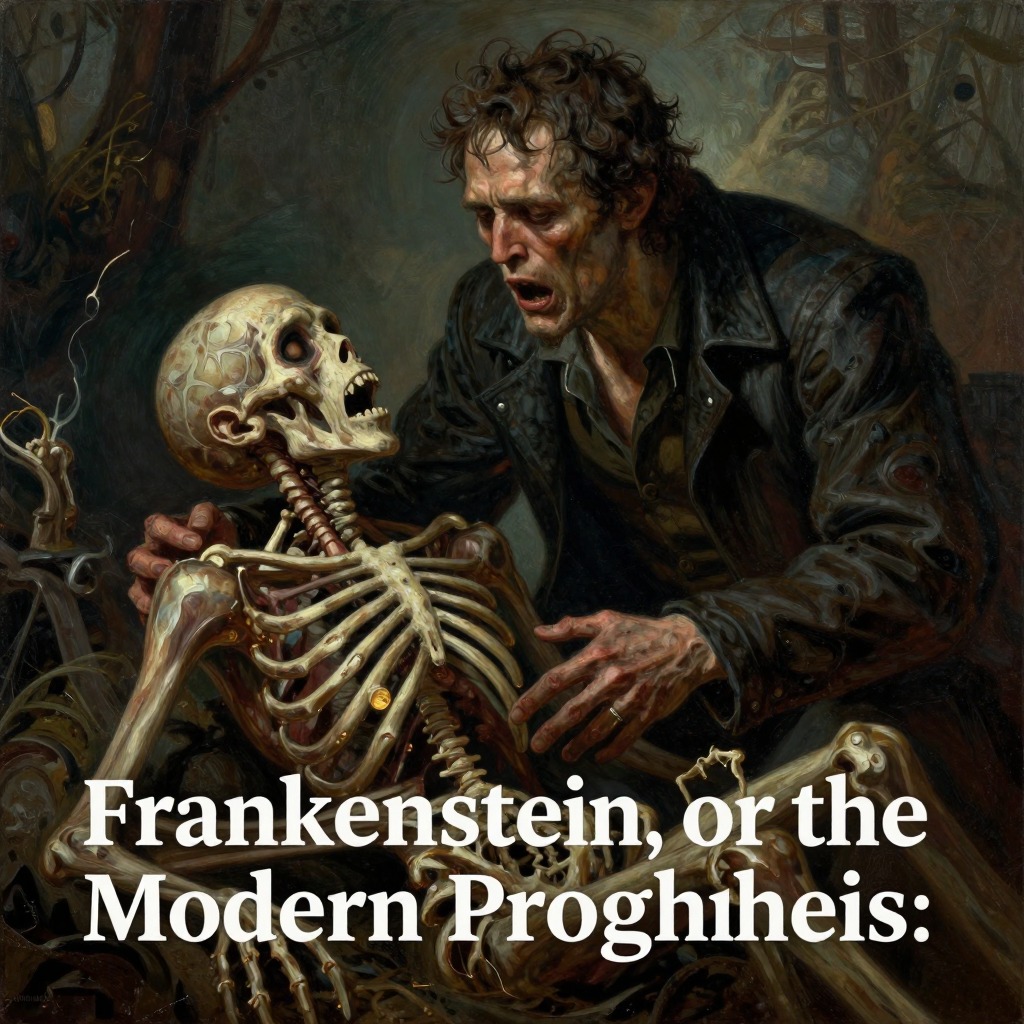
Victor completes his work, infusing a spark of being into the lifeless body at his feet. The creature's dull yellow eye opens, and it breathes. However, Victor is immediately horrified by the grotesque appearance of his creation. The beauty of his dream vanishes, replaced by breathless horror and disgust. He rushes from the room, unable to bear the sight of the monster he has brought to life.
the night of the creation
Victor's Nightmare
Victor falls into a troubled sleep and has a nightmare. He dreams of Elizabeth, who turns into the corpse of his dead mother. He wakes to find the monster standing over him, grinning and muttering. Terrified, Victor flees from his apartment and spends the night walking in the courtyard, consumed by horror and regret.
the morning after the creation
Arrival of Henry Clerval
Victor, wandering the streets in a daze, encounters Henry Clerval, who has just arrived in Ingolstadt. Victor is overjoyed to see his friend, and for a moment, he forgets his horror. He returns to his apartment to find that the monster has fled. Victor's relief is short-lived, as he is soon overcome by a nervous fever.
several months after the creation
Victor's Nervous Fever
Victor falls into a severe nervous fever that lasts for several months. Henry Clerval nurses him back to health, concealing the extent of his illness from Victor's family. During his delirium, Victor raves about the monster, but Henry dismisses it as the wanderings of a disturbed mind. Victor slowly recovers, and by spring, he is well enough to leave his sickroom.
during Victor's convalescence
Letter from Elizabeth
Victor receives a letter from Elizabeth Lavenza, who expresses her relief at his recovery and shares news from Geneva. She tells him about the growth of his younger brother Ernest and the return of Justine Moritz to the household after her mother's death. The letter is filled with warmth and affection, reminding Victor of the happy life he has left behind.
after his recovery
Victor's Aversion to Science
As Victor recovers, he develops a violent antipathy to natural philosophy. The sight of a chemical instrument or the praise of his professors fills him with agony. Henry Clerval, sensing this, removes all of Victor's scientific apparatus. Victor finds solace in studying oriental languages with Henry, a pursuit that offers a temporary escape from his guilt.
spring, before Victor's return to Geneva
Pedestrian Tour with Clerval
Victor and Henry take a pedestrian tour of the environs of Ingolstadt. The fresh air and beautiful scenery, combined with Henry's cheerful companionship, help to restore Victor's spirits. He feels a sense of peace and happiness that he has not known since before the creation. This idyllic interlude is a brief respite before the next tragedy.
May 12th, 17—
News of William's Murder
Victor receives a letter from his father, Alphonse, bearing terrible news: his younger brother, William, has been murdered. The letter describes how William's body was found with the print of a murderer's finger on his neck. A valuable miniature portrait of Caroline Beaufort, which William had been wearing, is missing. Victor is devastated and immediately sets out for Geneva.
the night of his arrival in Geneva
Victor Sees the Monster at Plainpalais
Victor arrives in Geneva late at night and, unable to rest, goes to the spot where William was murdered. During a violent thunderstorm, he sees the monster lurking in the gloom. He instantly becomes convinced that the creature is the murderer. The monster escapes into the mountains, and Victor is left in anguish, realizing that he has unleashed a killer upon the world.
the day after Victor's return
Justine Moritz Accused
Victor learns that Justine Moritz has been accused of William's murder. The missing miniature portrait was found in her pocket. Victor knows she is innocent, but he is unable to reveal the truth about the monster without appearing mad. He is tormented by the knowledge that he is the true cause of the tragedy.
the day after Victor's return
Trial of Justine Moritz
Justine is put on trial for the murder of William. Despite Elizabeth's impassioned defense and her own calm protestations of innocence, the circumstantial evidence is overwhelming. Victor is wracked with guilt, knowing that he could save her by confessing the truth. The court finds Justine guilty.
after the trial
Justine's Confession and Execution
Victor and Elizabeth visit Justine in prison. Justine confesses that she was pressured by her confessor into making a false confession. She is resigned to her fate and dies on the scaffold. Elizabeth is heartbroken, and Victor is consumed by an even deeper guilt, knowing that his creation has now caused the deaths of two innocent people.
after Justine's execution
Victor's Despair and Solitude
Victor is overwhelmed by remorse and despair. He shuns human company and seeks solitude, often taking a boat out on the lake at night. He contemplates suicide but is restrained by thoughts of his family and his duty to protect them from the monster. He lives in constant fear of the creature's next attack.
two months after Justine's death
Victor's Journey to Chamounix
Seeking relief from his intolerable mental anguish, Victor travels to the valley of Chamounix. He hopes that the sublime beauty of the Alps will help him forget his sorrows. The majestic scenery provides a temporary sense of peace, but his inner turmoil soon returns.
the day after arriving in Chamounix
Encounter on the Glacier
Victor ascends to the glacier of Montanvert. There, he is confronted by the monster, who approaches him with superhuman speed. Victor curses the creature, but the monster speaks, pleading for a chance to tell his story. He argues that Victor, as his creator, owes him a hearing. Reluctantly, Victor agrees to listen.
after the encounter on the glacier
The Monster's Tale Begins
The monster leads Victor to a mountain hut and begins his narrative. He describes his first confused sensations after being created, wandering through the forest near Ingolstadt. He experiences hunger, cold, and fear, and is bewildered by the world around him. He learns to distinguish his senses and discovers fire, which provides him with warmth and light.
after leaving the forest
The Monster's Arrival at the Village
The monster leaves the forest and encounters a village. He is horrified by the violent reaction of the villagers, who attack him with stones and drive him away. He takes refuge in a low hovel attached to a cottage, where he begins to observe a family. This marks the beginning of his long period of secret observation.
during the winter and spring
The Monster Observes the De Laceys
The monster secretly watches the De Lacey family: the blind old father, his son Felix, and his daughter Agatha. He is captivated by their gentle manners and their evident affection for one another. He learns their language by listening to them and begins to understand the complexities of human society. He also discovers the pain of poverty and the joy of kindness.
during his observation of the De Laceys
The Monster's Self-Discovery
The monster sees his own reflection in a pool and is horrified by his own ugliness. He realizes that his appearance will always inspire fear and disgust in others. This discovery fills him with a deep sense of loneliness and despair. He also finds Victor's journal in his pocket, which reveals the details of his creation and confirms his monstrous nature.
spring
Arrival of Safie
A beautiful Arabian woman named Safie arrives at the De Laceys' cottage. She is the daughter of a Turkish merchant and is in love with Felix. Her arrival brings joy to the household and dispels their sadness. The monster learns more about human relationships and the power of love by observing Felix and Safie's interactions.
during Safie's stay
The Monster Learns History
Felix teaches Safie from Volney's 'Ruins of Empires.' The monster listens and learns about the history of human civilization, including its wars, injustices, and social hierarchies. He is struck by the disparity between the noble ideals of humanity and its base actions. This knowledge deepens his sense of alienation and his understanding of his own wretchedness.
during his time in the hovel
The Monster Reads Paradise Lost
The monster finds a copy of Paradise Lost, Plutarch's Lives, and The Sorrows of Werter. He reads them with intense emotion. He identifies with Adam, but also with Satan, feeling himself to be a fallen creature, excluded from the joys of others. These books shape his understanding of the world and his place in it as an outcast.
during the monster's observation
The De Laceys' Story Revealed
The monster learns the history of the De Lacey family. They were once wealthy and respected in France, but they were ruined after Felix helped Safie's father, a Turkish merchant, escape from prison. The Turk betrayed them, and the family was exiled, losing their fortune. This story of injustice and ingratitude further fuels the monster's sense of the world's cruelty.
after learning the De Laceys' story
The Monster's Attempt at Friendship
The monster decides to approach the blind De Lacey, hoping that the old man will not be prejudiced by his appearance. He enters the cottage and speaks with De Lacey, who is kind and sympathetic. However, before the monster can fully explain himself, Felix, Agatha, and Safie return. They are horrified by the monster's appearance, and Felix violently drives him away.
after the monster's attack
The De Laceys Flee
After the violent encounter, the De Lacey family decides to leave their cottage. The monster overhears Felix telling a neighbor that they can never return. The monster is filled with rage and despair, realizing that he has lost the only people who might have accepted him. He burns the cottage to the ground in a fit of fury.
after burning the cottage
The Monster's Journey to Geneva
The monster decides to seek out his creator, Victor Frankenstein, in Geneva. He travels south, enduring great hardships. He saves a young girl from drowning, but is shot by her companion. This act of ingratitude confirms his hatred for humanity. He arrives in the environs of Geneva, determined to confront Victor.
after arriving in Geneva
Murder of William Frankenstein
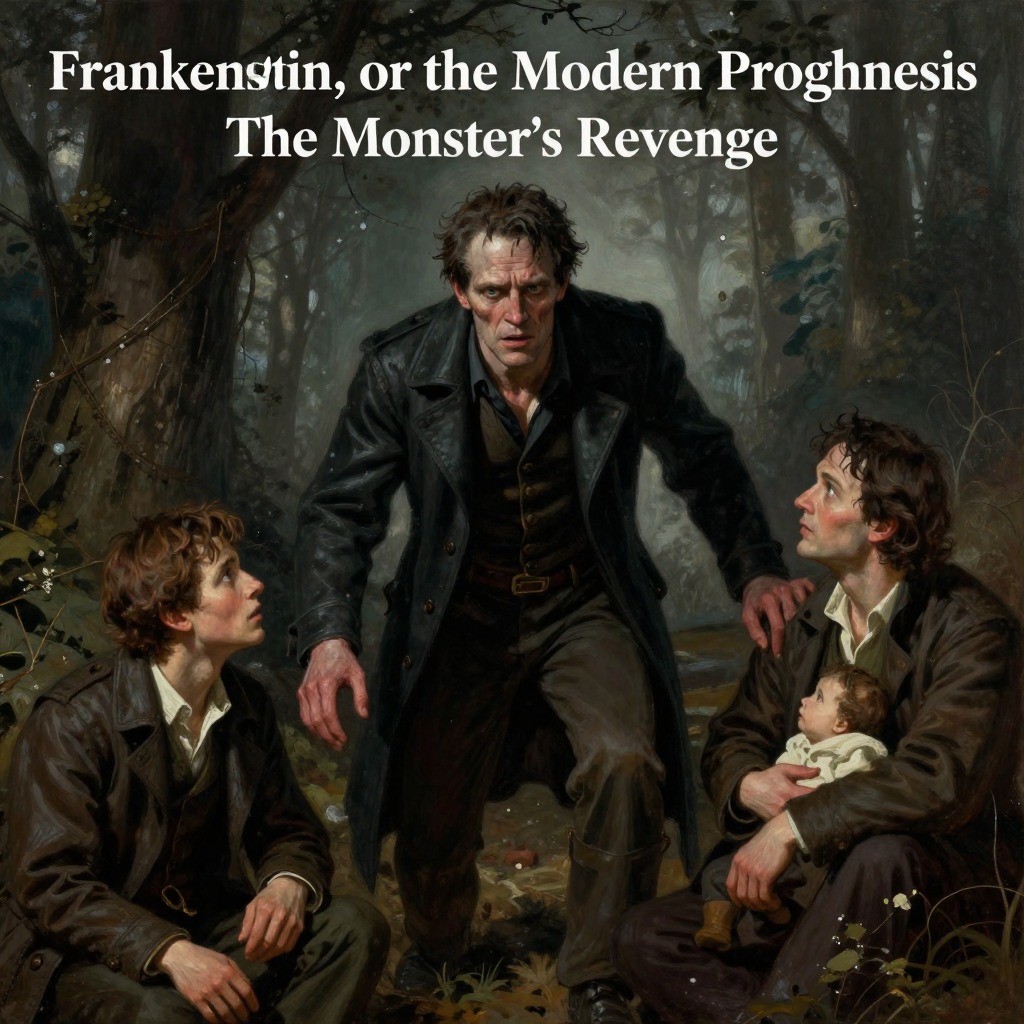
The monster encounters William Frankenstein in a wood. He initially hopes to befriend the child, but William is terrified and reveals that his father is M. Frankenstein. Enraged, the monster strangles the boy. He then sees the miniature portrait of Caroline Beaufort and, in a fit of spite, places it in the pocket of Justine Moritz, framing her for the murder.
on the glacier
The Monster's Request for a Female
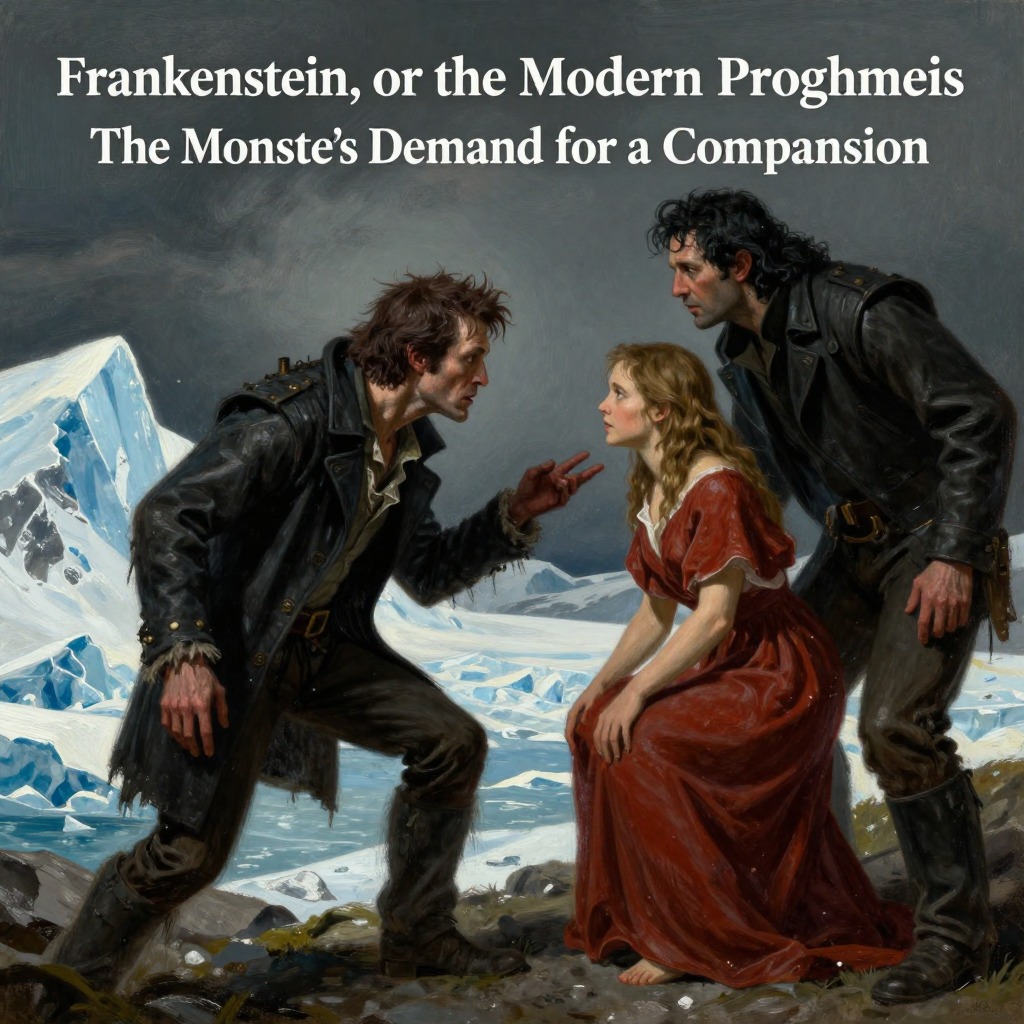
The monster concludes his tale by demanding that Victor create a female companion for him. He argues that he is miserable because he is alone and that a companion would make him peaceful. He promises to leave Europe forever if Victor grants his request. Victor is initially horrified, but the monster's arguments and threats begin to sway him.
after the monster's plea
Victor's Agreement
After a long and agonizing debate, Victor agrees to create a female companion for the monster. He is moved by the monster's arguments and fears his power. The monster swears to leave Europe forever and never bother humanity again. Victor, however, is filled with dread and uncertainty about the consequences of his promise.
after the encounter on the glacier
Victor's Return to Geneva
Victor returns to Geneva, his heart heavy with the burden of his promise. He is unable to confide in his family and feels increasingly isolated. He decides to travel to England to gather the necessary knowledge and materials for his new creation, hoping that the journey will also provide him with a temporary escape from his misery.
after Victor's return to Geneva
Victor's Father Proposes Marriage
Alphonse Frankenstein, noticing Victor's continued melancholy, suggests that he should marry Elizabeth immediately. Victor is thrown into turmoil, as he is bound by his promise to the monster. He cannot marry Elizabeth while the threat of the creature hangs over them. He uses the need to travel to England as a reason to delay the wedding.
late September
Victor and Clerval Travel to England
Victor and Henry Clerval depart for England. They travel down the Rhine, enjoying the beautiful scenery. Victor is haunted by his secret, but Henry's cheerful company provides some solace. They arrive in London in late December, where Victor plans to gather the information he needs for his task.
several months
Victor's Time in London
Victor and Clerval spend several months in London. Victor meets with natural philosophers to gain the knowledge necessary for his work, but he finds no pleasure in society. He is tormented by his secret and the memory of his crimes. Clerval, meanwhile, is full of energy and plans for his own future, including a voyage to India.
February to July
Journey to Scotland
Victor and Clerval travel north through England, visiting Oxford, Matlock, and the Lake District. Victor is eager to reach a remote location where he can begin his work. They eventually part ways in Scotland, with Victor heading to the Orkney Islands to work in solitude, while Clerval stays with a friend in Perth.
after arriving in the Orkneys
Victor's Work on the Orkney Islands
Victor settles on a remote Orkney island and begins the loathsome task of creating a female monster. He works in a state of constant horror and disgust, his mind filled with dread. He is haunted by the fear that the monster is watching him and by the potential consequences of his actions.
one evening in his laboratory
Victor Destroys the Female Creature
As Victor works, he is overcome by a vision of the potential horrors that could result from creating a second monster. He imagines a race of devils that could threaten all of humanity. In a fit of revulsion, he tears the half-finished female creature to pieces. The monster, who has been watching through the window, lets out a howl of despair and rage.
after the destruction of the female
The Monster's Wedding-Night Threat
The monster confronts Victor in his room, furious at the broken promise. He threatens Victor, saying, 'I shall be with you on your wedding-night.' Victor tries to attack him, but the monster escapes. Victor is now certain that the monster will kill him on his wedding night, and he resolves to fight to the death.
the next day
Victor Disposes of the Remains
Victor packs the remains of the female creature into a basket and takes it out to sea in a small boat. He throws the basket overboard, hoping to dispose of the evidence. A storm arises, and he is driven far out to sea. He eventually lands on the coast of Ireland, exhausted and disoriented.
after landing in Ireland
Victor Accused of Murder in Ireland
Victor is greeted by a hostile crowd in an Irish town. He is accused of murdering a young man who was found strangled on the beach. He is taken before a magistrate, Mr. Kirwin. When he is brought to see the body, he is horrified to discover that it is Henry Clerval.
after Clerval's murder
Victor's Imprisonment and Illness
Victor is overcome with grief and guilt at the sight of Clerval's body. He falls into a violent fever and is imprisoned for two months. During his delirium, he raves about his crimes, calling himself the murderer of William, Justine, and Clerval. He is eventually acquitted when it is proven that he was on the Orkney Islands at the time of the murder.
after his release from prison
Victor's Return to Geneva
Victor's father, Alphonse, arrives in Ireland to take him home. They travel to Paris, where Victor's health slowly improves. He is still consumed by guilt and despair, but he is determined to return to Geneva to protect his remaining family from the monster. He finally agrees to marry Elizabeth, believing that the monster's threat is directed at him alone.
before leaving Paris
Letter from Elizabeth
Victor receives a letter from Elizabeth, who expresses her love for him and her fear that he may not wish to marry her. She offers to release him from their engagement if he loves another. Victor is moved by her devotion and writes back, assuring her of his love and promising to reveal his terrible secret to her after their wedding.
ten days after his return to Geneva
Victor's Marriage to Elizabeth
Victor and Elizabeth are married in a ceremony in Geneva. Victor is filled with a sense of doom, knowing that the monster's threat hangs over him. He carries pistols and a dagger, prepared for a confrontation. After the wedding, the couple departs for a honeymoon at Villa Lavenza on Lake Como.
the wedding night
Murder of Elizabeth
Victor and Elizabeth arrive at an inn in Evian. Victor, expecting an attack, leaves Elizabeth alone in their room while he searches for the monster. He hears a scream and rushes back to find Elizabeth dead, strangled by the monster. He sees the monster at the window, jeering, and fires a pistol at him, but the creature escapes into the lake.
after Elizabeth's murder
Death of Alphonse Frankenstein
Victor returns to Geneva and tells his father the news of Elizabeth's death. The shock is too much for the elderly Alphonse, who dies in Victor's arms a few days later. Victor is now utterly alone, his entire family destroyed by the monster. He is consumed by a maddening desire for revenge.
after his father's death
Victor's Vow of Revenge
Victor is released from a brief imprisonment, having been judged mad. He visits the graves of his family and swears a solemn oath to pursue and destroy the monster. He hears the monster's mocking laugh and sees him in the moonlight, beginning a relentless chase that will take him across the globe.
many months
Victor's Pursuit Across the World
Victor pursues the monster through Europe, across the Mediterranean, and into the wilds of Russia and Tartary. The monster leaves taunting messages for him, guiding him northward. Victor endures incredible hardships, but his thirst for revenge keeps him alive. He eventually procures a sledge and dogs to continue the chase across the frozen wastes.
after a long pursuit
Victor's Arrival at the Arctic Ocean
Victor reaches the Arctic Ocean, where he sees the monster only a day's journey ahead. He continues the chase across the ice, but a ground sea splits the ice, separating him from his enemy. He is left drifting on an ice floe, exhausted and near death, when he is rescued by Walton's ship.
on Walton's ship
Victor's Story Concludes
Victor finishes his narrative, warning Walton of the dangers of ambition. He asks Walton to promise to continue his quest for revenge if he dies. Walton is deeply moved by the story and by Victor's noble character. He records the tale in his letters to his sister.
September 2nd
The Sailors' Mutiny
Walton's ship becomes trapped in ice, and the sailors, fearing for their lives, demand that he turn back. Walton is torn between his own ambition and his responsibility to his crew. Victor, despite his weakened state, gives a passionate speech urging the men to be brave, but his efforts are in vain.
September 12th
Walton's Decision to Return
Walton reluctantly agrees to return south if the ship is freed. He feels his hopes of glory are crushed. The ice breaks, and the ship begins its journey back to England. Victor, seeing that his own quest is over, grows weaker and prepares for death.
September 12th
Victor's Death
Victor Frankenstein dies peacefully in his cabin on Walton's ship. In his final moments, he urges Walton to avoid the dangers of ambition and to seek happiness in tranquillity. He expresses a sense of relief, believing that he will soon be reunited with his loved ones in death.
after Victor's death
The Monster's Final Appearance
Walton enters the cabin to find the monster mourning over Victor's body. The monster expresses his own profound remorse and misery, explaining that he was driven to evil by the cruelty he suffered. He declares that his work is done and that he will now die. He vows to build a funeral pyre and end his own miserable existence.
after his final speech
The Monster's Departure
The monster bids farewell to Walton and leaps from the cabin window onto an ice raft. He is quickly borne away by the waves and lost in the darkness and distance. Walton is left to ponder the tragic story he has witnessed, a tale of ambition, creation, and the destructive power of isolation and revenge.